
What Causes Sewer Backup? Sorting the Causes by Location

What causes sewer backup is easier to follow when the causes are sorted by where they sit. Wastewater leaves a house through one pipe, joins a larger public pipe, and travels on to treatment. A restriction or an overload at any point along that path can send it the wrong way.

The sources for this post are utilities and health departments, not plumbing companies, and the examples come from several different places. Local conditions vary, so treat this as a map rather than a diagnosis.
Problems on the household side

Ohio's health department lists blockages and a breakdown in sewer pipes among the reasons sewage comes back through floor drains or fixtures. Several utilities name what people put down the drain. Pittsburgh Water names grease, hair and other solid buildup. One Oregon sewer authority warns that grease sticks to the inside of the pipes and builds until it can block them completely, and that wipes and paper towels marked disposable or flushable do not break down like toilet tissue. Naperville's utility makes the same point about paper towels, diapers and flushable wipes.

The habits that keep a household line clear, from grease to wipes to planting near the lateral, are collected in everyday habits that lower the odds of a backup.

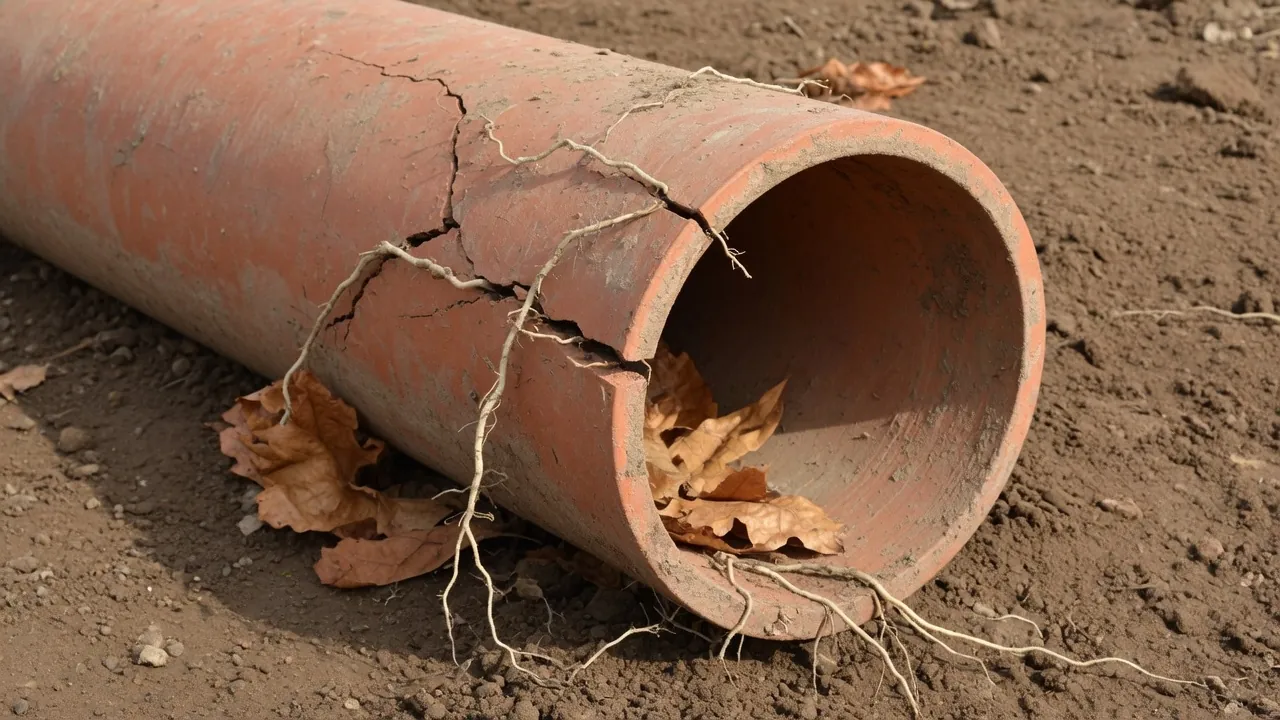
Cracked orange clay pipe lying on dry soil with thin pale roots draped over it and dry leaves inside its open end.

The pipe running out to the street

The lateral, the pipe that runs from the house to the public sewer, is where many of the causes sit. Madison says a sewer backup is a blockage in either the private lateral or the city main. Cracks and tree roots are a recurring theme. Naperville puts roots at the top of its list: roots seeking moisture slip into cracks, grow, and eventually obstruct the line. DC Water's brochure says the blockage grows worse as roots, once they locate moisture, keep growing.

An Oregon authority adds that roots can tangle with tissue and grease and press on pipes until they crack or collapse. Pittsburgh television covered a tree whose roots crushed a line in East Liberty.

The public main and the system around it

Sometimes the fault is not on the property at all. Madison describes a city main that debris has plugged or that has collapsed. EPA lists blockages, line breaks, power failures, improper design and vandalism among the possible causes of sanitary sewer overflows, and sewer defects that let stormwater and groundwater overload the system.

Indiana's health department adds capacity: systems that cannot handle newly developed residential or commercial areas. Who answers for which stretch is a separate question that has a post to itself.

Weather and the rest of the system

Connecticut's health department says large volumes of storm water and ground water entering sewage systems can inundate them and cause backups into basements. Pittsburgh Water likewise lists an overwhelmed system during heavy rain among the causes. Rain is therefore a cause that arrives from outside the house. The mirror-image question, what a house shows before the water appears, is answered in a post on early warning signs.

That is also why the Pittsburgh guide to the opening stretch of a backup includes checking whether neighbors have the same problem.

Telling the causes apart

  • One fixture only, with every other drain working: Naperville calls this an internal problem.
  • Several fixtures, or the lowest drain first: Madison says sewage tends to appear at the lowest fixtures in the house.
  • During or after a downpour: the weather-related causes above.

Fixing the pipe and cleaning the room are different jobs. For the room, the Contact Us page gets your details to a contractor near the address; this site has no cleaning crew of its own.

Common questions

Not by Naperville's account. A problem at only one fixture while all other drains work is an internal one, while a backup involves the line shared by the house.
Naperville says roots enter through cracks in the pipe, and an Oregon sewer authority says roots tangled with tissue, grease and debris can crack or collapse a pipe, so roots and other debris often work together.
Connecticut says large volumes of storm water and ground water can inundate sewage systems, and Pittsburgh Water names an overwhelmed system during heavy rain as a cause.