
Floor Drain Backing Up When Doing Laundry: What the Pattern Suggests

A floor drain backing up when doing laundry has one clear feature: it has a trigger. The basement drain behaves while the machine is idle, then wets the floor when the washer pumps out. This post stays on that single trigger and leaves the rain-driven and general cases to the pages that cover them.

The sources are utilities and a flood handbook. None of them is about washing machines in particular, so the reasoning below leans on what they say about shared lines and lowest openings.
Where the washer's water goes

Denver's flood handbook sketches a typical house with a basement: one sanitary line carries away waste from toilets, tubs used for laundry, and the basement floor drain. The washer is not a separate system, since its water joins the same pipes.

The handbook also calls the floor drain the sanitary system's lowest opening in the house. When that shared line is blocked, wastewater from a load of wash has the same destination as everything else, and the lowest opening is where it comes out.

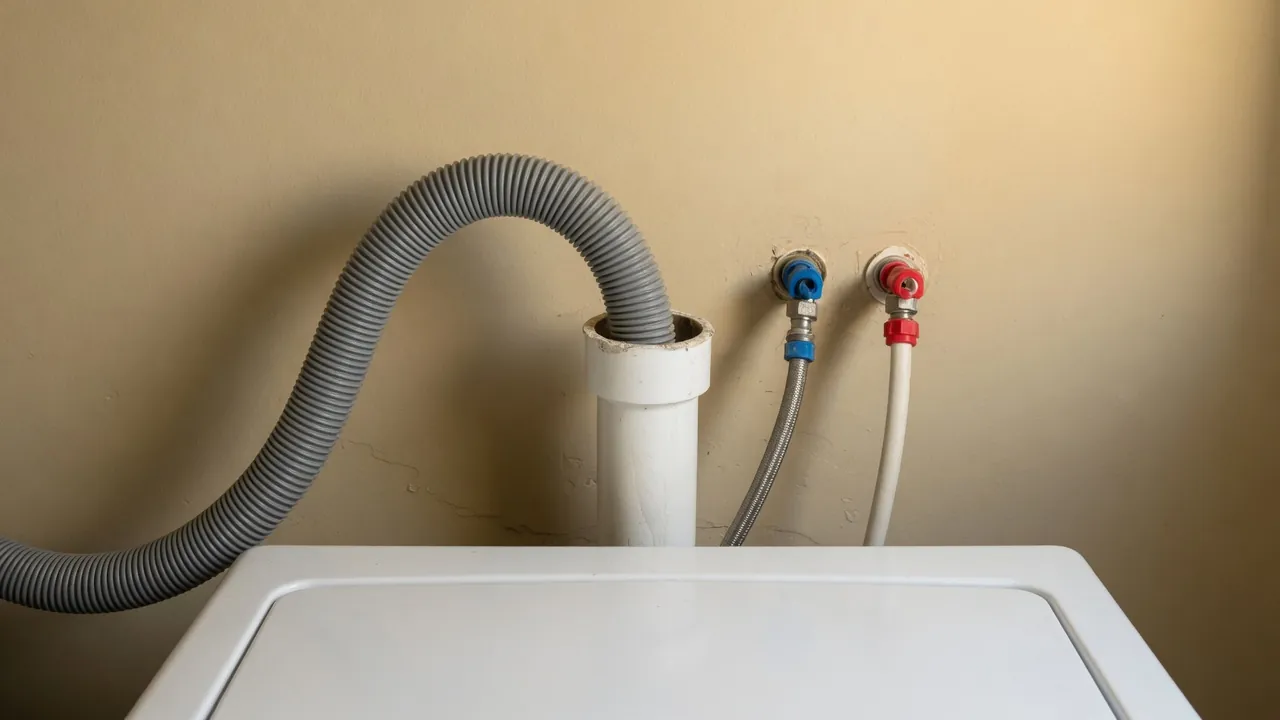
Gray ribbed hose entering a white pipe in a beige wall behind a washing machine, next to blue and red water valves.

Appliance load on a shared line

Indian River County's utility department lists the washing machine among the ordinary ways a main sewer line clog shows itself: water goes down one drain and appears at another, because it cannot get through the clog. A sewer authority in Oregon puts the advice in plain terms: a washer or dishwasher can set off backups, so heavy-flow appliances wait until slow drainage has been cleared.

Madison's engineering division widens the instruction to all water use: stop it throughout the house. The same page counts washing machine water as wastewater, the kind of water that goes to the treatment plant, which is why running another load only adds to the problem.

Steps that make it worse

  • Do not run a second load to see whether it happens again. The advice from every source above is to stop adding water.
  • Do not try to stop the flow. Seattle's utility says not to attempt to block the sewage coming up a floor drain or any other drain.
  • Do not assume a plug in the drain fixes anything. Denver's handbook warns that the water then looks for the next opening down, a laundry tub or basement toilet for example.

Is it only on laundry day?

Naperville's utility separates cases by how many drains are involved. A backup from a floor drain, it says, should be reported to the utility before a plumber is called, especially during heavy rain, while trouble at one fixture with every other drain fine is an internal problem. A drain that backs up only when the washer drains is, by that logic, still a floor drain reporting a backup, even if the washer is the cause of the surge.

Madison describes a way to find out who owns the problem: watch what happens once the city clears its main. When the sewage drains away down the floor drain, the main was the issue; when the water stays put, the private lateral is at fault. The Pittsburgh floor drain page, with its clues about timing and water use, covers related patterns, a filling tub is a close cousin, and a list of early plumbing warnings puts the laundry trigger in context.

Spreading across the floor

Standing water around a laundry area is treated as sewage-contaminated. For a concrete laundry-room floor, Colorado's health department suggests scrubbing it well and giving it time to dry. Rubber boots, gloves and goggles are the CDC's suggestion for anyone who has to enter.

For the floor around the machine, details sent through Contact Us can reach a contractor covering the neighborhood. The site itself has no crew.

Common questions

The sources do not say. They describe a shared line with a restriction; the washer is simply a heavy-flow appliance that sends water into it.
Utilities say no. An Oregon authority advises leaving heavy-flow appliances off until slow drainage is cleared, and Madison says to stop all water use.
That depends on where the blockage is. Madison says a lateral blockage is the property owner's job, and a city main blockage is the city's.